India suffered a heavy 50-run defeat against New Zealand in the fourth T20I at Visakhapatnam, but one fielding moment from Hardik Pandya stood out in an otherwise difficult night for the hosts. Hardik Pandya produced a sharp throw that sent Mitchell Santner packing. Before that, India won the toss and decided to bowl first. The decision did not work in their favour. New Zealand’s batters adapted quickly to the conditions. The pitch offered good pace and bounce.
Tim Seifert gave New Zealand a strong start wherein he played positive cricket from the beginning. He used the power play well and found gaps regularly. Devon Conway supported him with fluent strokeplay. The opening partnership put India on the back foot early.
India tried to slow the scoring rate with spin and changes in pace. However, New Zealand kept the pressure on. The visitors crossed 100 runs without losing control of the innings. Even after Conway’s dismissal, the momentum stayed with the batting side.
Daryl Mitchell played an important role in the latter half of the innings. He attacked the Indian bowlers and targeted the shorter boundaries. New Zealand looked set for a very big total as the final overs approached.
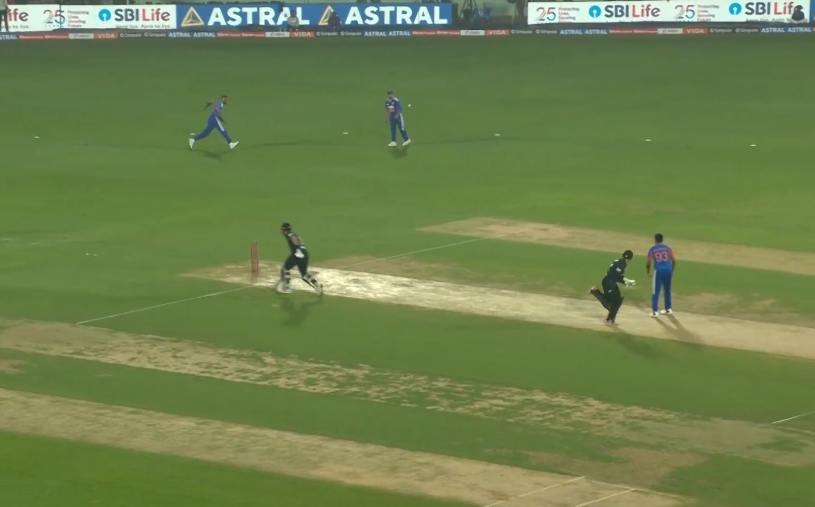
Absolute missile from Hardik Pandya sends Santner back in Vizag
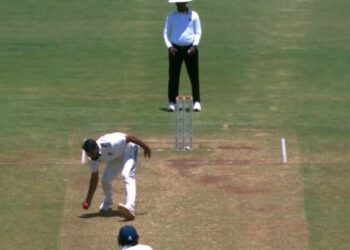
At that stage, India managed to pull things back briefly through alert fielding. Mitchell Santner attempted a quick single during the 17th over. Hardik Pandya reacted immediately as he collected the ball cleanly and threw it straight at the stumps at the non-striker’s end. The throw was so accurate that Santner failed to make his ground and was given run out.
The dismissal stopped New Zealand’s momentum for a short period. Santner had started to accelerate and looked capable of adding quick runs at the death. Pandya’s effort prevented further damage in the closing overs.
ALSO WATCH: Harbhajan Singh rolls back the years to get rid of Shikhar Dhawan in World Legends Pro T20
New Zealand finished with a strong total of 215 for 7. The score gave their bowlers a comfortable margin to work with. It also placed significant pressure on India before the chase even began.
India’s reply never fully settled. The required run rate was high from the start. Early wickets made the situation worse. The top order struggled to build partnerships. Several batters got starts but failed to convert them into big scores.
Shivam Dube provided some hope in the middle overs. He played aggressively and backed his strength. He hit cleanly down the ground and over the leg side. His innings briefly reduced the required run rate and lifted the crowd very well. He scored a quickfire 63 off 23 (3 fours, 7 sixes) but was run out in an unfortunate manner.
Rinku Singh tried to hold the innings together at the other end, but that didn’t turn out well. New Zealand’s bowlers mixed up their lengths and speeds well. They did not allow India to build long partnerships.
As the chase progressed, the target moved further away. The required run rate climbed sharply. India eventually lost all their wickets for 165 in 18.4 overs. New Zealand sealed the match with a 50-run victory.
The result helped New Zealand restore some confidence after earlier losses in the series. Team India have already won the series by winning three games on the trot before losing to the visitors in the fourth game. The fifth and final T20I will kick off on January 31 at Greenfield International Stadium, Thiruvananthapuram.
After the match, Suryakumar Yadav explained the decision to bat second. “We’ve been batting really well when we’ve batted first. So I wanted the guys to take that responsibility if we’re chasing 180 or 200, and two wickets or three wickets are down and see how we bat. So it’s a good challenge. Hopefully if we get an opportunity again in the next game, we might chase again. But at the end of the day, good learning. With the heavy dew, I think one or two partnerships here and there, like the way Dube batted, one batter with him would have made a lot of difference at the end of the game. We lost by 50 runs but it’s okay. As I said, one or two partnerships like this in a run-chase like this might make a difference,” he added.