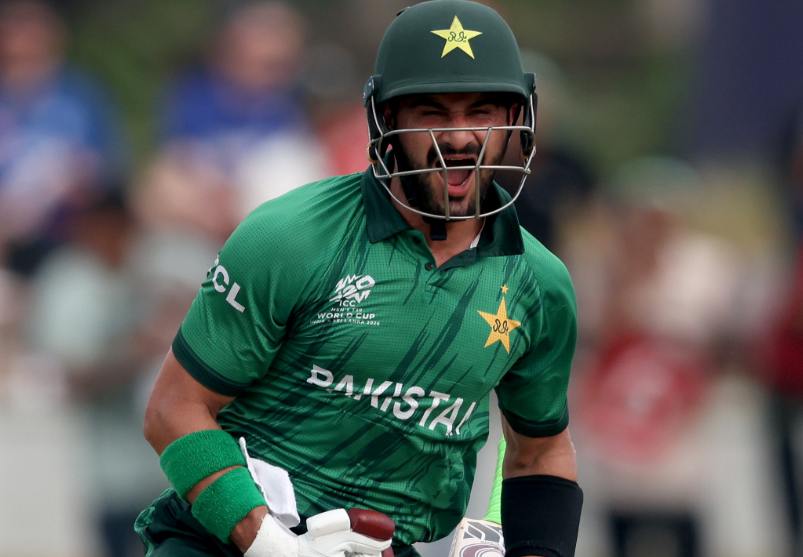
The group stage of the T20 World Cup 2026 belonged to batters who respected conditions and chose the right moments to attack. While several players produced quick cameos, only a few managed to influence matches pretty well.
At the top of the list are three names who did far more than accumulate runs. They gave their teams control, something that often decides T20 games long before the final over begins.
1. Sahibzada Farhan
Pakistan’s T20 template has been questioned for years, especially the tendency to start cautiously and play catch-up later. Sahibzada Farhan flipped that script in this tournament and changed Pakistan’s batting narrative.
He tops the run charts of the group stage with 220 runs. The unbeaten hundred was the obvious highlight, but the real value of his performance lay in the way he approached the powerplay. There was no hesitation in taking on bowlers, and yet there was no sense of recklessness. He completed his century in just 57 balls and helped his team set a commanding total in a must-win match against Namibia.
That balance allowed Pakistan’s middle order to walk in without scoreboard pressure, a rare sight in ICC events. More importantly, his intent forced opposition captains to rethink their plans early in the innings.
Pakistan sides have often depended on anchors. Farhan’s success suggests a shift towards a more modern, proactive approach. If that continues, the team suddenly looks far more dangerous in knockout cricket.
READ MORE: BBL eyes historic India debut as Chennai emerges as front-runner for 2026-27 season opener
2. Pathum Nissanka
Pathum Nissanka’s 199 runs might appear quiet when placed next to more explosive strike rates in the tournament, but his impact was anything but quiet.
His century came in a high-pressure situation and showcased a skill that remains invaluable in global tournaments: the ability to chase without panic. There was no rush, no visible anxiety, just a steady construction of an innings.
On surfaces where timing the ball was not always easy, his method of finding gaps, running hard, and picking the right deliveries to attack proved far more reliable than constant boundary-hunting.
Sri Lanka’s batting often looks most settled when Nissanka bats deep. His presence allows stroke-makers around him to play naturally. That role does not always dominate highlight packages, but it wins matches.
3. Kusal Mendis
Kusal Mendis did not produce a century in the group stage, yet his three successive half-centuries were among the most valuable contributions of the round.
Each innings came in a different situation. One stabilized the side after early wickets, another ensured a competitive total, and the third guided a chase. That adaptability is what made his tournament special.
There was a visible awareness in his shot selection. Risk was taken only when necessary. On slower tracks, he relied on placement rather than power. When bowlers missed their lengths, he punished them immediately.
Such innings often go unnoticed because they are not built on constant six-hitting. However, they form the backbone of successful campaigns.
A strong sign for Pakistan and Sri Lanka in T20 World Cup 2026
Pakistan will see Farhan’s form as more than just a personal success. It solves a structural issue that has existed for multiple ICC tournaments, the lack of momentum in the first six overs. Sri Lanka, on the other hand, will take immense confidence from having two players in the top three. It reflects a batting unit that is working in sync rather than depending on individual brilliance.
The challenge will now change. The group stage rewards form. The knockout phase tests temperament. If these batters continue in the same manner, reading conditions early and pacing their innings smartly, they will not just remain among the leading run-scorers. They will shape the outcome of the tournament. Because in T20 World Cups, the most valuable runs are not always the fastest ones. They are the ones that give a team control.